

Effective Ways to Improve Office Security in London: A Complete Guide for UK Businesses
Office security is no longer simply about locking the doors at the end of the working day. With businesses increasingly relying on digital technology, flexible working arrangements and shared office spaces, protecting commercial premises requires a more comprehensive approach.
For businesses across London and the Home Counties, office security is particularly important. Offices may contain expensive IT equipment, confidential business records, valuable stock and sensitive employee or customer information. At the same time, busy commercial areas, shared buildings and frequent visitors can create additional security challenges.
A well-planned office security strategy combines physical protection, modern security technology and clear workplace procedures. From professional CCTV installation and access control systems to intruder alarms and employee awareness, the right measures can help reduce security risks and create a safer working environment.
In this guide, we explore practical ways to improve office security and explain how businesses in London can protect their premises, employees and valuable assets.
1. Install a Professional Office Access Control System
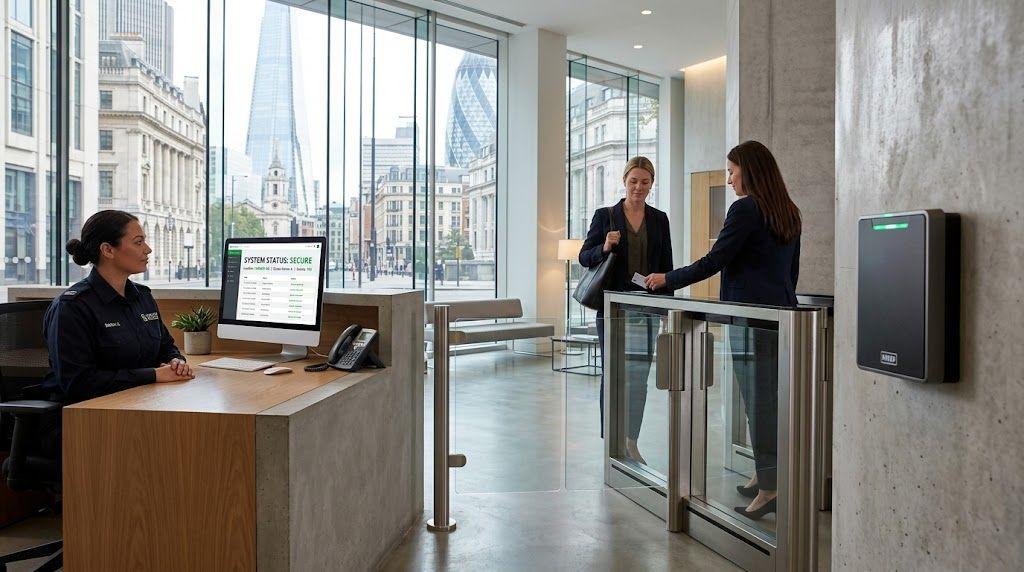
Controlling who can enter your business premises is one of the most effective ways to strengthen office security. Traditional locks and keys may offer basic protection, but they provide limited control over who enters the building and when.
Modern access control systems offer businesses greater flexibility and security by allowing authorised employees to enter designated areas using credentials such as:
- Key card and fob systems: Employees use programmed access cards or fobs to enter the building or restricted areas.
- PIN code entry systems: Keypads require users to enter an authorised security code before gaining access.
- Biometric access control: Fingerprint or other biometric authentication can provide an additional level of identity verification, subject to appropriate data protection considerations.
- Mobile access credentials: Certain modern systems allow employees to use compatible smartphones to unlock authorised doors.
For London offices with multiple departments, tenants or restricted working areas, access control can help prevent unauthorised entry into server rooms, management offices, storage facilities and other sensitive locations.
Businesses should also review access permissions regularly. When employees leave the company or contractors no longer require access, their credentials should be deactivated promptly.
An effective access control system can improve building security while providing a useful record of entry activity.
2. Install CCTV Cameras to Monitor Your Office Premises
A professionally installed CCTV system is an important part of an effective commercial security strategy. Cameras can help deter opportunistic theft, monitor vulnerable areas and provide valuable recorded evidence if an incident occurs.
For offices in London, CCTV coverage should be planned around the individual building layout and its potential security weaknesses.
Important locations to consider include:
- Main entrances and reception areas.
- Rear entrances and emergency exits.
- Car parks and vehicle access points.
- Corridors, stairwells and shared access areas.
- Stockrooms and equipment storage rooms.
- External building entrances and vulnerable perimeter areas.
Modern CCTV systems offer considerably more functionality than traditional analogue cameras. Businesses can choose high-definition cameras, network video recorders (NVRs), remote viewing facilities and intelligent video analytics, depending on their security requirements.
Remote CCTV monitoring can also allow authorised managers to view live footage from compatible smartphones, tablets or computers when away from the office.
However, installing cameras is only part of the solution. Businesses should ensure that cameras are correctly positioned, recording equipment is securely configured and footage can be retrieved when required.
CCTV must also be used responsibly. Businesses should establish a lawful purpose for surveillance, provide appropriate notices, restrict access to recordings and retain footage only for as long as necessary. The Information Commissioner’s Office (ICO) provides guidance on workplace surveillance and data protection.
3. Protect Your Office with a Reliable Intruder Alarm System
An intruder alarm system provides an additional layer of protection, particularly when offices are unoccupied outside normal working hours.
A professionally installed burglar alarm can detect unauthorised entry and activate audible warnings to help discourage intruders. Depending on the system and its configuration, it may also send alerts to designated keyholders or an alarm receiving centre.
Modern intruder alarm systems can incorporate different types of detection equipment, including:
- Passive infrared (PIR) motion detectors.
- Magnetic door and window contacts.
- Shock sensors to detect attempted forced entry.
- Glass-break detectors.
- External sounders and warning devices.
For larger London offices, a zoned or hybrid intruder alarm system may be particularly useful. It allows different sections of a building to be protected independently, providing greater flexibility for businesses operating across multiple floors or departments.
Alarm maintenance is equally important. Regular servicing helps identify faulty detectors, power supply problems, battery deterioration and communication issues before they compromise the system’s effectiveness.
Businesses should arrange periodic professional inspections to ensure their intruder alarm continues to operate reliably.
4. Strengthen Door Entry and Visitor Management
Office receptions are often the first point of contact for visitors, suppliers, contractors and delivery personnel. Without appropriate entry procedures, unauthorised individuals may gain access to areas where confidential information or valuable equipment is kept.
Installing a professional door entry system can help businesses manage visitors and control access to their premises.
Depending on the building’s requirements, suitable options include:
- Audio intercom systems for communicating with visitors before granting entry.
- Video door entry systems that allow reception staff to see visitors.
- Keypad entry systems for controlled access.
- Integrated door entry and access control solutions.
- Remote door release facilities for authorised personnel.
Video intercom systems can be particularly useful for offices where reception is not permanently staffed. Compatible systems may allow authorised employees to communicate with visitors and release the entrance remotely.
Businesses should also introduce a visitor management procedure. Visitors should be authorised, signed in where appropriate and directed to the relevant department or employee.
For multi-occupancy office buildings across London, these measures can help improve security without making everyday access unnecessarily complicated.
5. Secure Windows, Doors and Other Physical Entry Points
Even the most advanced electronic security equipment cannot compensate for weak physical building security.
Office managers should regularly inspect external doors, windows, locks and other potential entry points to identify vulnerabilities.
Practical improvements include:
- Installing high-quality locks on external doors.
- Using suitable deadlocks and additional door reinforcement where appropriate.
- Ensuring accessible windows are properly secured.
- Repairing damaged door frames, hinges and locking mechanisms.
- Improving lighting around external entrances and car parks.
- Securing access to loading bays, storage areas and service entrances.
Businesses occupying ground-floor offices or commercial premises with rear access should pay particular attention to less visible entry points.
Good external lighting can also improve visibility around the building and complement CCTV coverage.
6. Combine Physical Security Systems for Better Protection
One of the most effective ways to improve office security is to integrate different security technologies rather than relying on individual products.
For example, a business could combine CCTV cameras, an intruder alarm, access control and a video door entry system to create a more coordinated security arrangement.
These systems serve different purposes but can complement one another.
- CCTV: Provides visual monitoring and recorded footage.
- Intruder alarms: Detect potential unauthorised entry and generate alerts.
- Access control: Restricts entry to authorised individuals.
- Door entry systems: Help verify visitors before granting access.
An integrated approach can give office managers better visibility of building activity and help simplify day-to-day security management.
For businesses operating from larger premises in London and the Home Counties, a tailored security installation can be designed around the building’s layout, operating hours and specific risks.
7. Improve Cybersecurity and Protect Confidential Business Information
Office security is not limited to physical threats. Businesses must also consider the risks associated with computers, networks, cloud services and connected security equipment.
Modern CCTV and access control systems may be connected to business networks or accessed remotely. If these devices are poorly configured, they can introduce additional cybersecurity risks.
Businesses should consider the following measures:
- Use strong, unique passwords for security equipment and management accounts.
- Enable multi-factor authentication wherever supported.
- Keep CCTV recorders, cameras and access control software updated.
- Restrict system access to authorised employees.
- Use separate networks for business operations, visitors and security equipment where appropriate.
- Secure remote access to CCTV and other connected devices.
- Back up important business information securely.
The UK Government’s Cyber Security Breaches Survey 2025/2026 highlights the growing adoption of measures such as multi-factor authentication, restricted administrator privileges and separate staff and visitor Wi-Fi networks.
Combining physical security with appropriate cybersecurity measures helps businesses protect both their premises and the information stored within them.
8. Develop an Office Security Policy and Train Employees
Security equipment is most effective when supported by clear procedures and employee awareness.
Businesses should establish an office security policy explaining how employees, contractors and visitors are expected to behave when entering, using and leaving the premises.
An effective policy should cover:
- Procedures for locking doors and securing windows.
- Rules for issuing and using access cards and security codes.
- Visitor registration and authorisation.
- Reporting suspicious behaviour or security incidents.
- Procedures for lost keys, cards or access credentials.
- Emergency evacuation and incident response.
- Safe handling of confidential documents and business equipment.
Employees should also receive appropriate cybersecurity awareness training, including guidance on recognising phishing emails, protecting passwords and reporting suspicious digital activity.
Regular reminders and refresher training can help establish a stronger security culture throughout the organisation.
9. Arrange Regular CCTV, Alarm and Security System Maintenance
Installing security equipment is an important investment, but businesses should not overlook ongoing maintenance.
A CCTV camera that has stopped recording, a faulty alarm detector or an access control reader that no longer works correctly can create security weaknesses without being immediately obvious.
Professional maintenance helps identify potential problems and ensures that security equipment continues to operate as intended.
A regular maintenance programme should include:
- Testing intruder alarm detectors and sounders.
- Checking alarm batteries and power supplies.
- Inspecting CCTV cameras, lenses and connections.
- Checking DVRs, NVRs and recording equipment.
- Verifying recording quality during daytime and nighttime conditions.
- Testing access control readers, keypads and door release mechanisms.
- Reviewing system settings and identifying any faults.
Businesses should also review their security arrangements whenever they expand their premises, change office layouts or introduce new working arrangements.
For organisations in London, arranging professional CCTV maintenance, burglar alarm servicing and access control inspections can help maintain reliable protection throughout the year.
Why Is Professional Office Security Important for London Businesses?
London has a diverse commercial environment, ranging from small independent offices and retail premises to large corporate buildings and shared workspaces.
Each type of business faces different security requirements. A small office may primarily need reliable intruder detection and CCTV coverage, while a larger organisation may require integrated access control, multiple cameras and more advanced visitor management.
Professional security planning helps businesses identify the most appropriate solutions rather than investing in equipment that does not address their actual risks.
Effective office security can help businesses:
- Reduce opportunities for theft and unauthorised access.
- Protect employees, visitors and contractors.
- Safeguard computers, equipment and other valuable assets.
- Improve control over restricted areas.
- Protect confidential business information.
- Support business continuity and operational resilience.
- Build confidence among employees, customers and visitors.
Conclusion: Improve Your Office Security with Professional Security Solutions in London
Protecting a commercial property requires more than installing a CCTV camera or fitting a new lock. Businesses need a coordinated security strategy that combines reliable equipment, controlled access, regular maintenance and clear employee procedures.
Whether you operate a small office, a multi-floor commercial building or a shared workspace, investing in the right security measures can help protect your premises and reduce avoidable risks.
Looking for professional office security solutions in London or the Home Counties?
At Eagle Security Solutions, we provide a range of security solutions designed to help protect residential and commercial properties. From CCTV installation and maintenance to intruder alarm servicing, access control and door entry systems, we can help businesses identify suitable security options for their premises.
Don’t wait until a security incident exposes weaknesses in your existing arrangements.
Contact Eagle Security Solutions today to discuss your office security requirements and arrange a professional security assessment. Let us help you create a safer, more secure working environment for your business, employees and visitors.